Heartuned · The Heartuned Method
dysregulated parent
= dysregulated child
You snap at your kids, then hate yourself for it. A Licensed School Counselor explains why your body does it, and the 14-day reset that teaches it to pause first, a few minutes a day.
This letter is for you if
- You snap at your kids over small things, the spilled milk, the shoes, the third “why,” and hear a voice come out of you that you swore you would never use.
- It is worst when you are already running on empty: at 6pm, in the car, in a store with everyone watching.
- Afterward you replay it at 2am, and wonder what it is teaching them.
You know better. Your body snaps anyway.
It is 6pm. Dinner is late, someone is crying about the blue cup, and the milk goes over. Before you have decided anything, your jaw is tight and your voice is up. You hear it: the sharp voice, the one you promised yourself you would never use. Then you watch your child’s face change.
Then comes the worst part. The quiet after. The apology that does not land. Lying awake at 2am, replaying it.
And the worst ones happen in public. The meltdown in the church hallway, the grocery line or the school pickup, with other parents watching and a stranger stepping in to help. Trying everything to fix it, and nothing landing. Hearing your own voice go sharp in front of everyone, then the long walk to the car, both of you in tears.
If your child is the intense one, whose meltdowns are bigger and last longer, with a diagnosis or without one, your alarm gets set off ten times a day. Every one of them is a chance to snap.
You might recognize the signs:
- · Your shoulders, neck and jaw are tight so often that you forgot it is not normal.
- · A dropped dish makes you jump like a bomb went off.
- · You are exhausted, but the second you sit down, you feel restless.
- · You plan the exit before you walk into a store with your child.
- · You feel like the only one holding everything together.
Underneath all of it sits one quiet verdict. Being a good parent is the thing you most want to get right, and every time you snap feels like proof you are getting it wrong.
And the thought you would never say out loud: “I love my child, and some days I do not like being with them.” If that has crossed your mind, it says nothing about your love. It is what a body on high alert does to the people closest to it.
In thirty years, your child will either thank you. Or be in a therapist’s office trying to undo what they learned from your body.
Thirty years from now, your child will be an adult, with a kitchen table of their own and a Tuesday morning that looks a lot like yours. One morning a glass will tip, a child will whine, and something inside their body will decide what happens next. Not their mind. Their body. It will either settle, or it will ignite, and they will hear a voice come out of them that sounds nothing like the parent they wanted to be.
What happens in that kitchen will have been shaped by you. Not by anything you said. By what your body felt like to be around.
Your own pattern reached you the same way. Think of the voice that comes out of you at 6pm, sharp and fast. You have heard it before. You grew up next to it. Your body learned it by living next to the people who raised you, the same way your child is learning from yours right now.
And something else will have been decided by then. Whether you are the first person they call when their own life falls apart, or the one they call on your birthday because they should.
That is what “dysregulated parent equals dysregulated child” means. It is not a guilt trip. It is how it works.
Why nothing you have tried has worked. You have been using thinking tools on a body problem.
Let me guess what you have already tried.
Understanding it. Maybe therapy, maybe podcasts, maybe years of reading about your own childhood. That insight is real, and it has helped. But it lives in the thinking part of your brain, and the thinking part is the first thing to go offline when your alarm goes off. By the time you remember what you understand, you have already snapped.
The parenting books and their scripts. Name the feeling. Connect before you correct. You could explain all of it to a stranger. But every one of those scripts assumes you are calm when you say it. At 6pm, with dinner burning and your child on the floor, you are not.
A deep breath, in the moment. Everyone tells you to take one. You try, and your chest is too tight to take it. A breath your body has never practiced on a calm day will not show up on a hard one.
Self-care. The bath. The glass of wine after bedtime. They feel good, and they take the edge off today. They do not change what your body does at 6pm tomorrow.
You have been using thinking tools on a body problem.
So the snapping is not a character flaw, and it is not a lack of love. It is an alarm, going off before your thinking brain can reach the script. Your body learned it before you could choose. And what a body learned, it can learn again.
Your child borrows your calm. When your alarm goes off, they borrow the alarm.
A child cannot make calm yet. Their nervous system borrows it from the nearest adult body: your breath, your face, the tone of your voice, how tight your shoulders are. When your body is settled, they borrow settled. When your alarm is going off, they borrow the alarm, and no script you say on top of it changes what they borrow. Researchers call this co-regulation. We call it borrowed calm.
Three pieces of established research show it.
Edward Tronick, 1975. A developmental psychologist at Harvard asked mothers to hold a still, neutral face in front of their three-month-old babies. Within a couple of minutes, the babies tried to reach them, then turned away, then went limp. It is called the Still Face Experiment, and it is on YouTube. Children read the state of the adult in front of them, not their words.
Stephen Porges, 1994 and ongoing. A neuroscientist who spent decades mapping the vagus nerve, which decides whether a body is in fight-or-flight, shutdown, or calm. Children lock onto the state of the caregiver next to them and use it as their own. He named it co-regulation.
Ruth Feldman, 2010s and ongoing. A developmental neuroscientist at Bar-Ilan University measured mothers and babies together. Within minutes, their heart rhythms began to sync. The parent’s state became the child’s state, measurably, while nobody spoke.
Key idea
Your child’s nervous system regulates against yours, in real time, below words. A parent who knows the script but whose body is in survival mode is broadcasting survival mode. The child reads the broadcast, not the script.
Drawn from Tronick (1975, Still Face Experiment), Porges (polyvagal framework), and Feldman (Bar-Ilan University, 2010 to present).

My name is Lauren Haas, and I am the creator of the Heartuned curriculum. I am a Licensed School Counselor and a Nationally Certified Counselor, trained in EMDR, with a Master's in Counseling and currently a PhD student in Counseling. My work is children and families.
For a long time I thought parents needed better words for the hard moment. I was wrong. The parents who came to me had read everything. They knew their patterns and could trace them back to their own childhoods. And they still could not stop reacting.
What finally cracked it open was noticing what their children were responding to. Not the words. Not the technique. The state. A child reads the body it is standing next to, and it reads it constantly. You cannot lend calm you do not have. So I went to the body first, and built everything else on top of it.
So the fix is not a better script. It is a body that can pause.
If your child borrows your state, the most powerful thing you can change is your state. Not once, in the heat of the moment, when it is already too late. A few minutes a day, on ordinary days, so the pause is already there at 6pm.
That is what the 14-Day Reset does. Every day, a couple of minutes of the Parent Reset, the breathing practice that tells your body it is safe. Then one short lesson and one practice. By day 14 you have done every lesson in the course, and your body has practiced the way back 14 times.
Before
- Braced all day, shoulders up.
- Snapping over spilled milk.
- Replaying it at 2am.
- A child who watches your face.
What the 14 days are built for
- A pause, small at first, between the spilled milk and your voice.
- Shoulders that come down.
- Coming back to yourself in minutes, and going back to repair.
- A child who leans in.
Even on the day it goes wrong in front of everyone, the day is not lost. Repair is what happens after: a hot chocolate in a quiet corner, side by side, and one sentence that tells your child the two of you came through it. That is the part your child keeps.
And your child, growing up next to a body that has learned the pause, borrows that.
Everything in the 14-Day Reset.
Day 1 starts tonight.
Here is what is inside the moment you start.
The 14-Day Reset
A few minutes a day, one day at a time.
From bracing for 6pm to a body that knows the way back.
- Day 1: why you can't think straight once your alarm goes off, and the Parent Reset, a couple of minutes of breathing you will do every day after.
- Day 2: the earliest signs your alarm is going off, so you catch it sooner, while there is still a choice.
- Day 5: the plan for the hard moment, so you are not hunting for a speech while your child is on the floor.
- Day 9: how to go first after you snap, so the evening ends with a hug instead of a 2am replay.
- Day 11: the five-minute daily ritual that makes small safe moments add up.
- Your members area opens on today's step. Miss a day, and it waits for you.
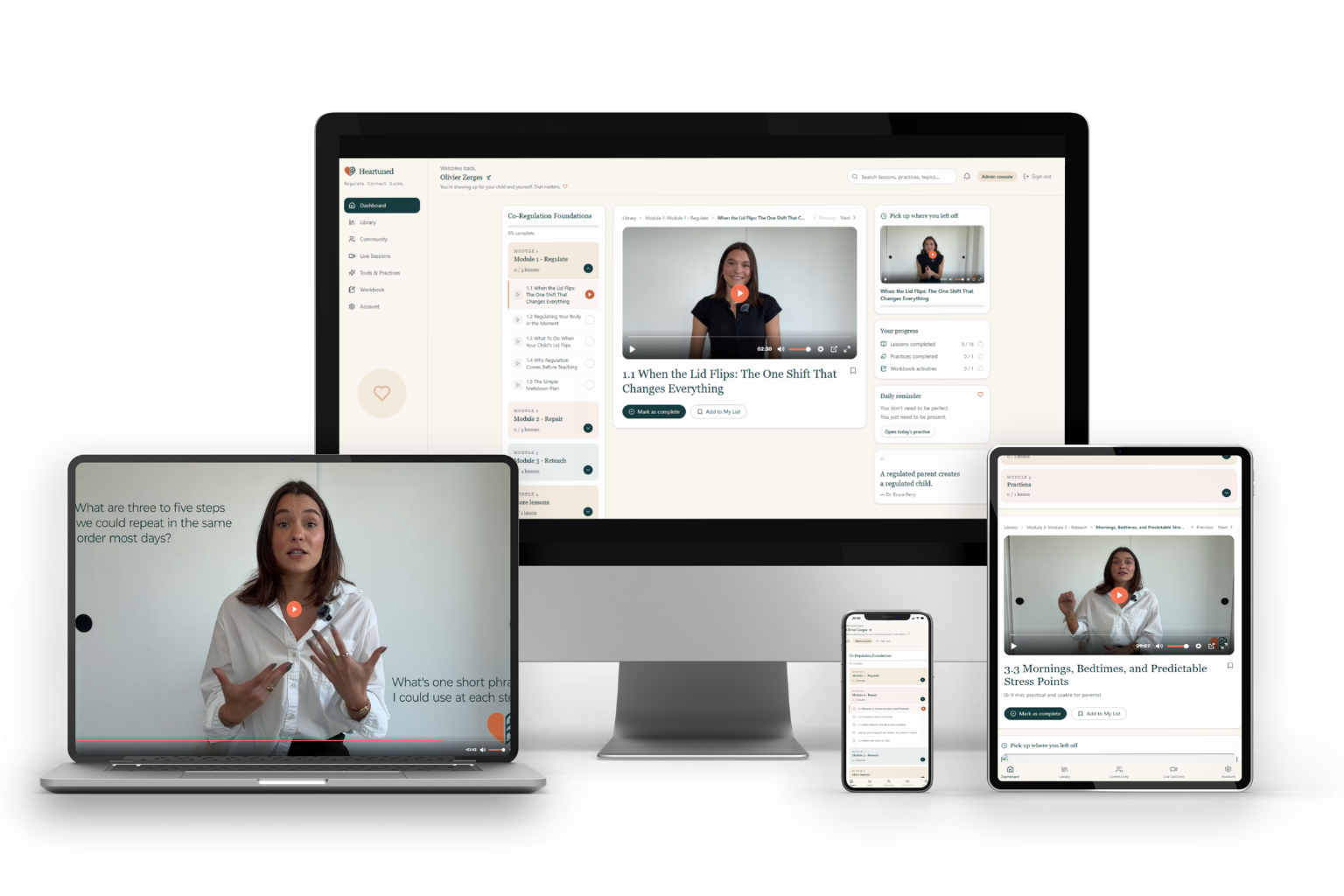
Module 1: Regulate
What to do in the moment.
From snapping in two seconds to a pause you can feel.
- The one shift that changes everything when a lid flips, yours or your child's.
- The earliest signs your body is about to snap, and quick tools that work anywhere, even in a store.
- What your child needs from you when their lid flips, before your words can reach them.
- Why the lecture rarely lands mid-meltdown, and the timing that makes it land later.
- The simple meltdown plan, with examples for hitting, refusing, leaving the park and bedtime.
- 6 guided practices, including the Parent Reset and Co-Breathing with your child.
Module 2: Repair
What to do after the hard moment.
From the 2am replay to the hug that ends the evening.
- Why behavior is communication, not character, and how to hear what it is telling you.
- How to be warm and still clear, even after it all went wrong.
- Why quiet does not always mean calm, and what to do when your child shuts down instead of exploding.
- The repair formula: four parts, in the order that rebuilds trust.
- For the night you were the one who lost it: how to come back without drowning in shame.
- 4 guided practices, including the Repair Script, where you go first.
Module 3: Reteach
What to build for next time.
From bracing for the same hard hours to hard moments that come less often.
- Why tiny safe moments count for more than one perfect day.
- How to teach your child the hand model, so the two of you share words for the hard moment.
- Mornings and bedtimes: the little bit of planning that changes the tone of the whole day.
- Family agreements, feelings and connection rituals, practiced when it is calm so they are there when it is not.
- 5 guided practices, including the Daily 5-Minute Connection Ritual.
The Moment Card
The second you feel it rising.
So the pause is in your pocket, not just in your head.
- Four steps, in the order your body can actually do them when your chest is tight.
- The one thing to do with your breath before you say a word.
- Sized for your lock screen, so it is there when your thinking brain is not.
The Public Meltdown Plan
When it happens with everyone watching.
So the store, the church hallway and pickup stop being places you dread.
- What to decide before you leave the house, so you are not deciding with everyone watching.
- What to do with your body while the stares land, and how to get you both to the door.
- What to say to the stranger who steps in. It is shorter than you think.
- The repair afterward, so one hard minute does not take the whole day.
The Repair Card
After you snap.
So a snap becomes something your child sees you mend.
- Why you settle your own body before you go back, and what goes wrong when you skip it.
- What to say, in order, so the apology lands.
- How to end the evening close, instead of replaying it at 2am.
30 days. If the 14 days do not help, every cent back, and you keep the cards.
No subscription, no expiry. Come back to the 14 days during any hard season.
Put together: fourteen days, a few minutes each, built to take you from the mom who snaps and replays it at 2am to the mom her child leans into.
More time doing the work than watching someone talk about it. A few minutes a day. Yours forever after that.
What changes
when the calm starts with you.
Individual results vary. These accounts reflect member experiences and are not a prediction of what your own outcome will be.
“I yelled at my kids for six years and was convinced I'd already broken something. The repair module doesn't tell you that you didn't do damage — it tells you what to do about it now. That's a more honest answer and I trusted the program more for it.”
“My son is autistic and I've had a lot of 'gentle parenting' content fall apart on contact with a real sensory meltdown. This didn't overpromise. It says clearly it's not a replacement for his OT or his IEP, and it isn't. What it gave me was something to do with my own body while I wait his meltdowns out.”
“Bought it at 11pm after a bad night, watched two lessons, went to bed. Used the script at breakfast the next morning over — I am not exaggerating — the wrong spoon. It didn't magically work. But I stayed in the room instead of walking out, and afterwards he came and leaned on me.”
“I'm a single parent and I kept skipping courses that assumed two adults. This one didn't. The repair module is what got me — I'd been apologizing constantly and it wasn't landing. Turns out I was doing it in a way that made my daughter comfort me. Changed how I go back in.”
“The 'Always-On Alarm' section was uncomfortable to read. My shoulders have apparently been up around my ears since roughly 2016. I'm not fixed. But I noticed it three times this week before it turned into snapping at someone, and that's three more times than last month.”
“I've read maybe nine parenting books. I could tell you exactly why I react the way I do. None of that helped me at 6pm. The two sentences did, mostly because I didn't have to think of anything. First night I used them my son still cried for ten minutes, but I wasn't yelling by minute three, which was new.”
Why I priced it the way I priced it.
The regular price of The Heartuned Method is $97. Compared to almost any other route into this work, that is already inexpensive. One session with a parenting coach runs one hundred fifty to two hundred fifty dollars and is gone in an hour. A multi-week course runs three hundred to eight hundred, and is easy to abandon halfway through.
My view is that the right number of parents doing this work is more, not fewer. While the launch campaign is running, the price is $16.99 for everything above: the 14-Day Reset, the whole course and the three cards. One payment, lifetime access, no subscription.
$16.99 in context.
- · One session with a parenting coach: $150 to $250, and you cannot replay it at bedtime
- · A multi-week parenting course: $300 to $800
- · Another year of the same hard evenings and the same guilt after: free, and you have been paying it the whole time
What happens when you click the button.
You click. You create your account and pay on the secure checkout. You land in your members area with everything unlocked: Day 1 of your reset, the three cards and every lesson. Do your first Parent Reset before bed.
Card or PayPal on the next page. One payment. Lifetime access. 30-day guarantee. No subscription. Ever.
The Calm Evening Guarantee.
Do the 14 days. Watch the lessons, do the practices, keep the cards where you can see them. If it does not help, email us any time in the first 30 days and we refund you in full. No forms, no hoops, no exit survey. You keep the cards.
This is not a subscription. There is nothing to cancel. Nothing recurring. You pay $16.99 once and it is yours, including every future update.
The risk should not sit with the parent who is already carrying the most. So it does not. It sits with us.
From here, the choice is yours.
Somewhere down the road, your child is going to have a very bad day. At five, it is a tower that fell over. At thirty, it is a job, a marriage, or a baby who will not sleep. What this whole letter is about is who they reach for on that day, and whether your voice is the one that helps them settle.
You can close this tab and go back to the evenings you have been living in. There is no judgment in that.
Or you can spend $16.99, do your first Parent Reset tonight, and find out what 14 days of a few minutes can do for the pause before you snap. If it does nothing for you, the guarantee is built for exactly that.
The launch price ends when the campaign ends. It returns to $97 at that point, and there will be no warning email, because this paragraph is the warning.
Card or PayPal on the next page. One payment. Lifetime access. 30-day guarantee. No subscription. Ever.
Thank you for reading this far.
One more thing, because nobody says it to you. This is not only for your child. You deserve to live in a body that is not braced all the time. You deserve evenings that do not end with you lying awake at 2am, replaying the day. Your child will feel the difference. So will you.
Card or PayPal on the next page. One payment. Lifetime access. 30-day guarantee. No subscription. Ever.
Honest answers to honest questions.
What exactly am I buying?
The 14-Day Reset and the full Heartuned Method: 15 guided practices, 14 short lessons and 3 modules, the Moment Card, the Public Meltdown Plan and the Repair Card, lifetime access, and the 30-day Calm Evening Guarantee. One payment, no subscription. $16.99 during the launch campaign, $97 after.
How much time does it take a day?
A couple of minutes for the Parent Reset, and a few more for the day's lesson and practice. That is the whole day. It is built for tired parents, and you can do it with your kids in the next room.
What if I miss a day?
Pick up where you left off. Your 14 days wait for you, and everything stays yours for good.
I have read all the parenting books and I still lose it. Why would this be different?
Because the books gave you thinking tools, and the hard moment happens when thinking brains go offline. This starts with your body: short practices done on ordinary days, so your nervous system has a way back even when your chest is tight.
Is this a subscription?
No. One payment, lifetime access. There is nothing recurring, so there is nothing to cancel later.
My partner isn't on board. Does this work if it's just me?
Yes. Your child borrows calm from whichever body is closest, and one steadier body changes the room. This starts with whichever parent picks it up first.
My child is neurodivergent (ADHD, autism, big sensory needs). Does this apply?
The method teaches regulation, not diagnosis, and settling your own nervous system first is the same foundation clinicians across specialties build on. Nothing in it conflicts with therapy, an IEP, or specialist care, and it does not replace them. If it does not fit your child, the 30-day guarantee is exactly for that.
I have been yelling for years. Is the damage already done?
It is not too late, and this fear is exactly why repair is a whole module and a card. A parent who reliably comes back matters more than a parent who never ruptured. Start lending a different state now, and your child starts learning from it now.
My child is older than 7. Is it too late?
No. The examples center on ages 2 to 7, but your body's reset works the same at any age, and children keep reading the calm around them well into their teens.
Is this therapy?
No. It is an educational program, not treatment, and it does not replace care from a professional. If your child needs clinical support, please reach out to one.
What if it does not work for us?
Email us any time in the first 30 days and we refund you in full. No forms, no hoops. You keep the cards.
How do I actually start?
Click any button on this page. You create your account, pay on the secure checkout, and you are in your members area about a minute later, with Day 1 ready tonight.
Card or PayPal on the next page. One payment. Lifetime access. 30-day guarantee. No subscription. Ever.
P.S. If you scrolled to the bottom: the 14-Day Reset puts the whole Heartuned Method on a daily path, a few minutes a day, so your body learns to pause before it snaps. The three cards come with it. Built for parents of kids about 2 to 7. $16.99 during the launch. Lifetime access. 30-day guarantee.
P.P.S. The single sentence most worth taking from this letter is this. Your child is not learning from your words. They are learning from your nervous system.
P.P.P.S. If you have a question this letter did not answer, write to us and a real person will reply. The replies are not instant. They are real.